The museum
We all play! Explore Toy Museum Mechelen and learn all about games and toys!
Let the games begin
We're so happy that you're planning a visit! Do you love playing games? Do you want to find out more about them? Then, Toy Museum Mechelen is the right place! You'll learn about our local games, both new and old.
When you visit, you'll be off on a fun tour through four galleries. In each gallery, look for the answer to a question. What is playing? How do we play today and how did we play in the past? Why do we play? And who actually plays?
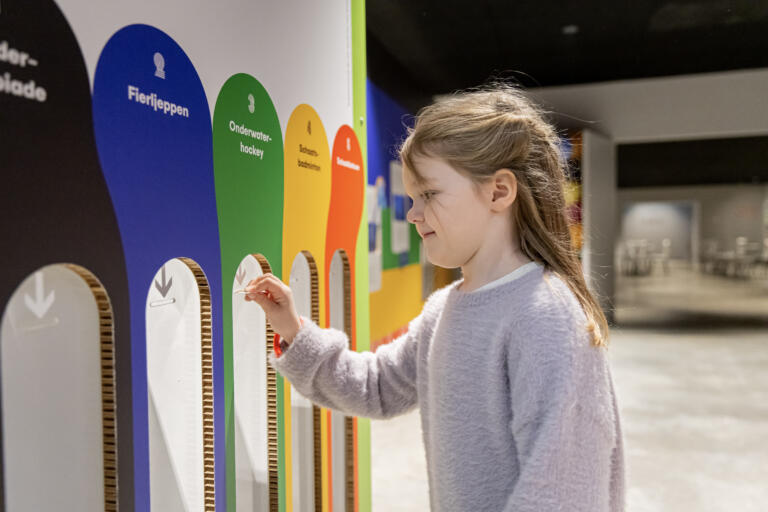
There is lots to look at. But that's not all. You can play too. In fact: you'll have to play if you want to complete your adventure.
Experience
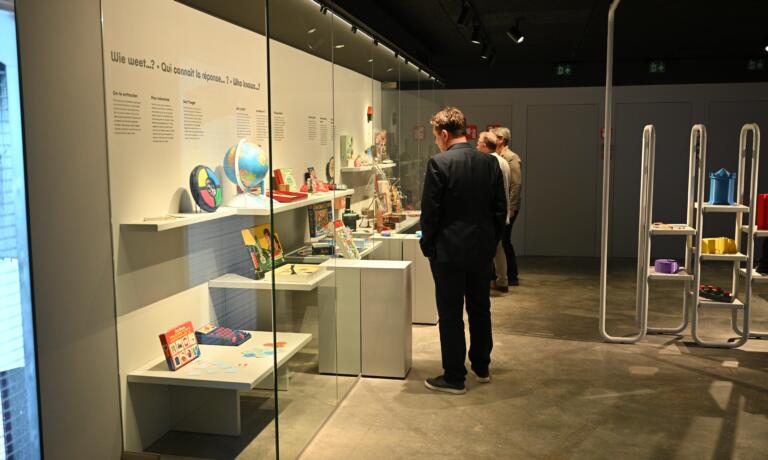
In addition to carefully selected collection pieces, recognizable for all generations, you will also be able to experience the story thanks to countless gaming experiences.
- By the way, did you know that you are challenged in a game? Score points during your museum visit with your personal wristband!
- Did you know that our current display contains just a glimpse of our total collection? Behind the scenes, we manage an extensive depot, these pieces are occasionally featured through a temporary exhibition.
- Want to know more about collection items? Scan your band at a horizontal floor display and get extra information! This makes your visit not only fun, but also enriching.
A museum visit takes about 2 hours, but when you play, you quickly lose track of time.
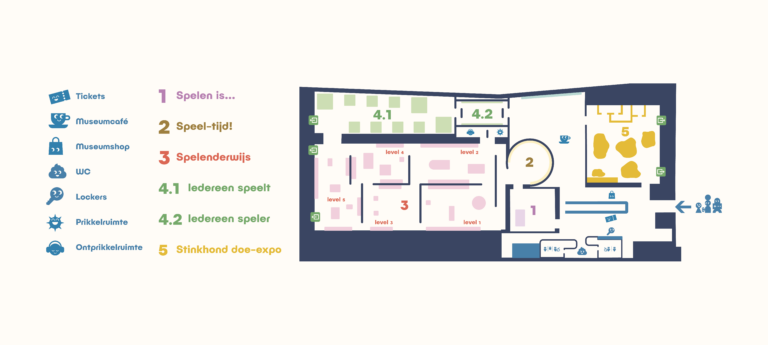
Floor plan
Download the map of Speelgoedmuseum Mechelen (NL) or view it here:
The collection
Toy Museum Mechelen preserves a collection of games and toy heritage, which includes more than 30,000 objects, with toys from the Middle Ages to the present day that were and are played with in our country. Most of the collection dates from the 19th and 20th centuries.
Toy Museum Mechelen wants to map and collect both the material and the immaterial and digital witnesses of the Belgian playing culture (objects, stories, archive and visual material) in order to tell how people used to play in our country and how they are playing in our country in the past.
Online search
Are you curious about which pieces Toy Museum Mechelen has in its collection? Part of our collection is accessible on erfgoedinzicht.be. You can search online.
Donations
Due to the busy schedule of the newly opened museum, we are temporarily not accepting donations. So keep your valuable toys for a while longer.
Documentation centre and library
Toy Museum Mechelen has a documentation centre and library with a lot of information on games, such as reference books on player heritage or toy advertising leaflets. At the moment, on-site consultation is not possible due to the relocation of our depot. As soon as this is possible again, you can read about it on our website!
Requesting loans
At the moment, we are unable to offer loans due to the relocation of our depot. As soon as this is possible again, you can read about it on our website!
Participate
By the way, do you like to play yourself? Then fill in our ‘Everyone Plays’ survey and help decide which playing heritage should be preserved by the Mechelen Toy Museum in the future.
Collection pieces in the spotlight
A sneak preview: five collection pieces from the permanent exhibition in the spotlight.
Seven white-grey earthenware marbles - 1600
Marbles are a game for the playground, the garden or the street. At one time the game was even played in graveyards or in church! We know that from old documents. Thanks to those documents and archaeological excavations, we know a lot about old games that were played here. Including the game of marbles. You can simply try to hit your opponent's marbles. In the game 'squares' or 'circles' you must try to shoot your opponent's marbles out of a square or circle. This is the variant you can spot on one of the pictures by Pieter Bruegel, whose illustrations provide a wonderful impression of everyday life and games from his time.
Porcelain doll with walking mechanism - 1890
When factories were built, toys also took on a new appearance. For example, in 1855 Jules Nicholas Steiner made a doll that could walk. Yet the doll only became popular at the end of the 19th century. This particular doll was made by Jumeau, the largest and most famous doll factory in France at the time. It is the oldest doll with a walking mechanism in the Toy Museum's collection. Jumeau won many awards, which are often displayed on the dolls. For example, 'Médaille d'or' (gold medal). In the late 19th century, Jumeau joined a number of other French companies in the Société Française de Fabrication de Bébés et Jouets (SFBJ).
Metal knucklebones - 1920
'Bikkelen' or knucklebones is played with small clumps of hard material, leading to the expression 'bikkelhard'. The game has been around for centuries. These knucklebones or jacks are made of metal and shaped like the original ones in bone. These were made from the ankle bones of animals like sheep, goats and pigs.
To be good at knucklebones you need some good dexterity. You take the knucklebones in your fist, throw them up and catch them on the back of your hand. If that's not hard enough, you must also catch them in a particular order. Phew!
Stratego with cardboard playing pieces - 1947
Stratego was invented in the Netherlands during the Second World War by Jacques Mogendorff. As a Jewish merchant, he was forced to hide. He invented the game with his sons at the kitchen table. Smeets &
Schippers received the first licence to launch the game. As from 1958, Jumbo was permitted to distribute the game. First in Europe, but soon afterwards worldwide as well. Stratego was quickly in-cred-ib-ly popular. This one is the second Dutch edition. It is almost identical to the first version. The playing pieces are like those in 'Monopoly', that was also launched by Smeets &
Schippers during the Second World War. The aim of Stratego is to defend your flag with your army and to capture your opponent's flag. Strategic insight and a good memory help you to claim victory!
Giant Floor Puzzle Disney Winnie The Pooh - 2005
Doing puzzles is a wonderful way to pass the time, but in fact it is also very useful. When you think about the right place for a piece, you train your skills in depth and distance. Do you love doing puzzles? Do you still remember the first puzzle you made? Perhaps you also began with a floor puzzle with large pieces, like this one from Winnie the Pooh.